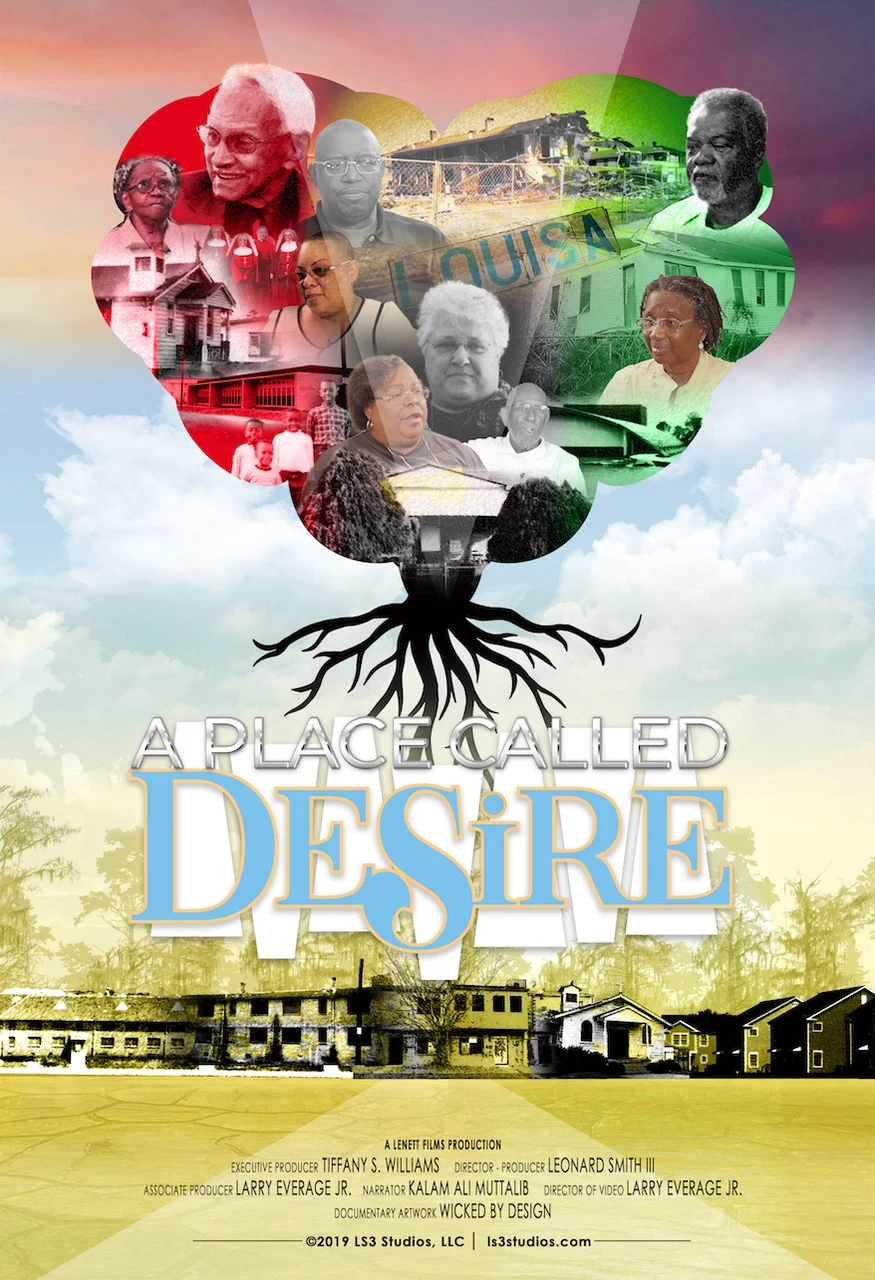
The Film · A documentary by Leonard Smith III
A community’s story, told by the people who lived it.
A Place Called Desire traces one of New Orleans’ earliest subdivisions for Black homeownership, and one of America’s largest housing developments, through more than sixty residents and former residents of the Upper 9th Ward.
Synopsis
Two disasters, one community, and a feeling of being forgotten.
A Place Called Desire shows how two powerful, catastrophic disasters took aim at a once tight-knit community, made worse by the lack of movement from local, state and federal governments.
Contrary to what the public was led to believe, there was a sense of normalcy growing up in the community of Desire. It was self-contained: churches of various denominations, public and private schools, shopping, eating establishments, food trucks, parks for children to run and play, and community centers for after-school tutoring and activities.
Homeowners shared streets with renters, and many families in government-subsidized housing dreamed of homeownership. Birthday parties in shaded backyards, grass mowing, vegetable gardens and life outdoors were constant happenings. But Desire’s seniors were housed in an apartment complex on land that would later be labeled a Superfund site, and the students of a neighborhood elementary school were exposed too. Then came Hurricane Katrina.
Since 2008, filmmaker Leonard Smith III, who grew up in Desire in the 1960s and ’70s, has recorded the people who know this story best. The result offers, in the words of historian Dr. Al Kennedy, “many unforgettable history lessons” and “shares hard truths with a gentle touch.”
Synopsis adapted from the project statement by Leslie Smith Everage.
Structure
Six chapters, seven decades.
OpenerA Place Called Desire
Who gets to tell a community’s story? The film opens from the inside, with the voices of people who grew up in Desire.
1940s – 1950sA Better Life
One of New Orleans’ earliest subdivisions for Black homeownership, and the opening of one of America’s largest housing developments.
1960s – 1970sIt Takes a Village to Raise a Child
Churches and schools, food trucks and record trucks, bookmobiles and the neighbors who raised everyone’s children. The years of Hurricane Betsy and the Black Panther standoff.
1980s – 1990sThe Struggle Is Real
Neglect, hardship and the Agriculture Street Landfill. A tight-knit community holding on.
ReckoningThe Good, the Bad, and the Ugly
Hard truths about government, housing and health, told with a gentle touch.
2000s“The New Desire”
Hurricane Katrina, displacement and the new development rising where the old one stood.
Smith enables the viewer to look beyond unfair stereotypes and see the thriving, loving community of Desire.Louisiana Trust for Historic Preservation, 2021 Louisiana Heritage Media Award
Recognition
Awards & festivals
“The most rewarding accolade is hearing from everyday viewers that our film resonated with them.” — LS3 Studios
- WinnerBest DocumentaryBlack Film Festival of New Orleans · 2021
- WinnerAudience Jury AwardBlack Film Festival of New Orleans · 2021
- WinnerLouisiana Heritage Media AwardLouisiana Trust for Historic Preservation · 2021
- Silver WinnerTelly Award2020
- Gold WinnerAVA Digital Awards2020
- Award of RecognitionThe Impact DOCS AwardsDocumentary Feature · 2020
- NomineeLEH Humanities Documentary Film of the YearLouisiana Endowment for the Humanities · 2020
- FinalistBest DocumentarySan Diego Black Film Festival · 2020
- SemifinalistRootsTech Film FestivalFirst RootsTech Film Fest
- Official SelectionNew Orleans Film Festival2020
- Official SelectionSan Francisco Black Film Festival2020
- Official SelectionParis Awards Film Festival
On television
Broadcast on WYES-PBS
A Place Called Desire aired Monday, February 7, 2022 at 9 p.m. on WYES-TV in New Orleans, with streaming on wyes.org/live and the WYES and PBS apps.
Bring Desire to your community